The clean-energy transition is moving fast. America can catch up.
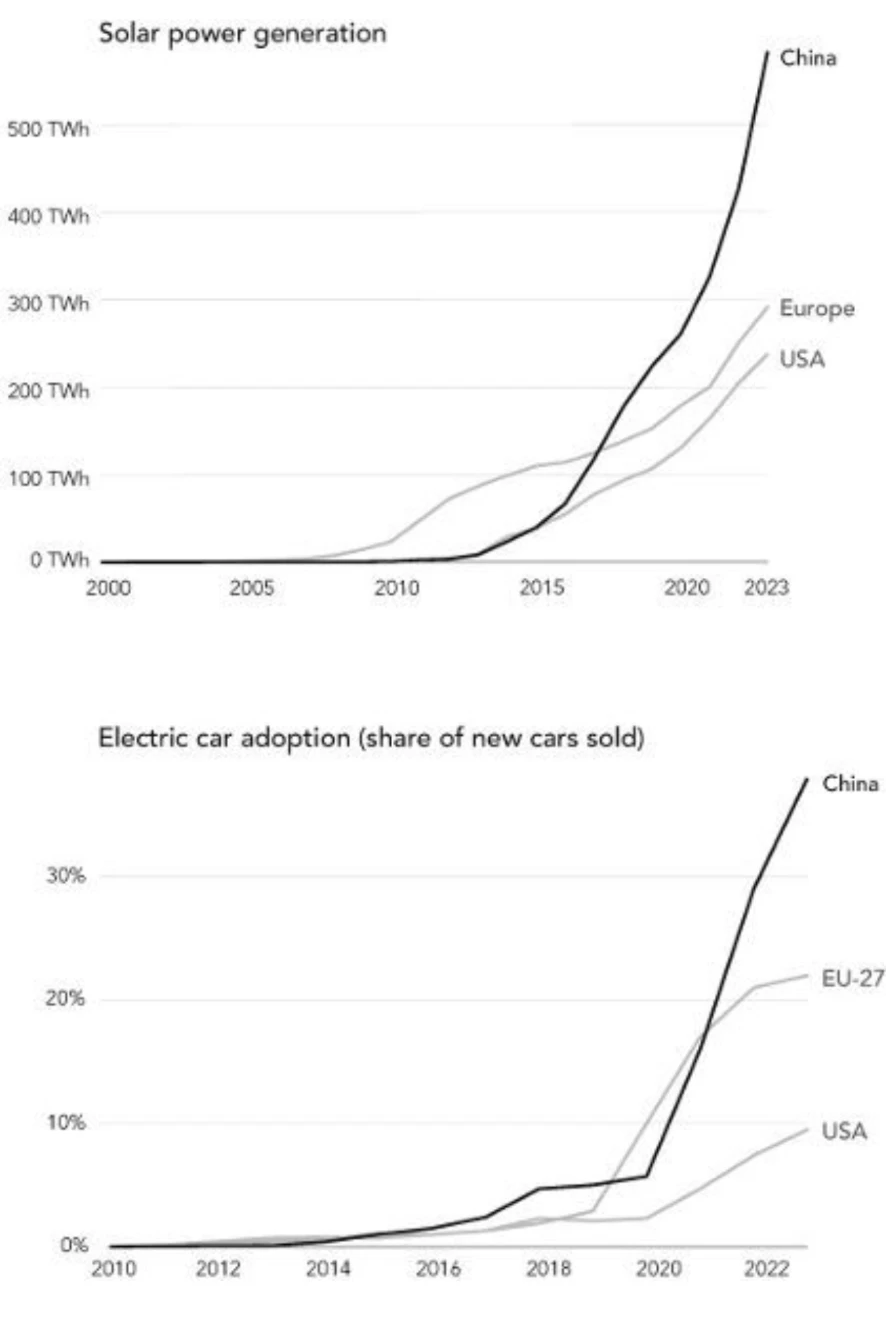
Climate news can leave us feeling that nothing is changing. Two graphs shared with Orange Environment tell a more encouraging story: people are generating more electricity from sunlight and buying more electric cars. The transition is real. But its pace is not the same everywhere—and the United States is not leading these comparisons.
That is not a reason to give up. It is a reason to ask what is working elsewhere, remove barriers here, and make our voices heard in New York.
What the solar graph actually shows
The upper graph measures solar electricity generation in terawatt-hours, or TWh. One TWh is one billion kilowatt-hours—the same unit used on your electric bill. It measures electricity actually generated, not the number of panels installed or their maximum power capacity.
Across the period shown, China's line rises sharply and overtakes Europe and the United States. The American line rises too, but more slowly. The important lesson is not that America has made no progress; it is that much faster deployment is possible.
There is an important limitation: these are total amounts, not solar generation per person or solar's percentage of each electricity system. China has a much larger population than the United States, and “Europe” is a group of countries. This graph cannot, by itself, tell us which country has the cleanest grid or establish that America trails every other country.
What the electric-car graph shows
The lower graph asks a different question: what share of new cars sold is electric? This percentage comparison shows how quickly buyers are adopting a technology, rather than simply how large a market is. China's share climbs above the European Union's and the United States'. It does not mean that the same percentage of all cars already on the road is electric.
The supplied excerpt does not include the original data notes, so we should not guess its precise vehicle definitions. For a separately documented comparison, the International Energy Agency's Global EV Outlook 2025 reports that in 2024 electric cars represented almost half of new car sales in China, around one-fifth in Europe, and more than one in ten in the United States. The IEA's electric-car category includes battery-electric cars and plug-in hybrids. These are 2024 observations, not a claim about today's sales. Source: https://www.iea.org/reports/global-ev-outlook-2025/executive-summary
China is building the tools of the transition
China's importance goes beyond installing panels and buying cars. It is a major manufacturing center for the equipment that makes the transition possible. The IEA's Energy Technology Perspectives 2026 describes China as accounting for around 85% of solar and 80% of lithium-ion battery supply-chain production capacity. These are manufacturing-capacity measures, not shares of electricity generation. Source: https://www.iea.org/reports/energy-technology-perspectives-2026/supply-chain-risks-and-industrial-competitiveness
The IEA also reports that China produced more than 70% of the world's electric cars in 2024. That is a manufacturing share, distinct from the new-car sales share in the graph. Source: https://www.iea.org/reports/global-ev-outlook-2025/trends-in-the-electric-car-industry-3
This is heartening evidence that clean technologies can scale. It also raises a practical challenge for the United States: invest in our own skills, infrastructure and manufacturing while building reliable, diversified supply chains. Recognizing China's progress does not mean overlooking its continuing fossil-fuel use or treating its energy transition as finished. More clean energy must ultimately displace fossil fuels, not simply accompany growing energy demand.
Progress is possible—not automatic
Solar panels, batteries and electric vehicles are not experimental ideas waiting for a breakthrough. They are already being deployed at scale. Yet no graph makes a fossil-fuel phaseout inevitable. Public policy, affordable options, transmission, charging access, responsible siting and community participation will shape how quickly the transition happens and who benefits.
For Orange County, supporting clean energy should go hand in hand with protecting water, farmland and habitat. We can favor suitable rooftops and already-developed spaces, improve efficiency, and scrutinize projects that add large new electricity demands. Climate action and thoughtful land-use planning belong together.
A concrete New York opportunity: the SUNNY Act
The Solar Up Now NY Act, known as the SUNNY Act, would make qualifying small, portable plug-in solar systems easier to use in New York. The Legislature passed A.9111-C/S.8512-C on May 28, 2026. The Senate's bill record reviewed for this article lists passage, not a governor's signature; November 19 reporting also describes the bill as awaiting Governor Hochul's action. Check the official record for subsequent changes. Official bill: https://www.nysenate.gov/legislation/bills/2025/S8512/amendment/C
The legislation addresses certified portable devices with a maximum aggregate continuous AC inverter output of 1,200 watts and would exempt qualifying devices from utility interconnection and net-metering requirements. It includes safety and installation conditions. This is not permission to plug any panel into any outlet: electrical safety, building requirements and property permissions still matter. It is a modest access measure, not a substitute for the wider grid transition. Legislative explanation: https://assembly.state.ny.us/leg/?Actions=Y&Memo=Y&Summary=Y&Text=Y&Votes=Y&bn=A09111&term=
Make your voice part of the transition
Ask Governor Hochul to sign the SUNNY Act if it is still awaiting her decision, and ask your state senator and assemblymember to support safe, accessible solar. Explain why it matters to your household: access to clean energy should not depend entirely on owning a suitable roof. The New York League of Conservation Voters provides background and an action link: https://www.nylcv.org/news/governor-hochul-sign-the-sunny-act-to-help-new-yorkers-power-up/
You can also write a short letter to the editor of the Warwick Advertiser or your own community newspaper. Share one clear fact, identify its source and year, and explain the local action you want readers to take. Bring this conversation to a town meeting, a neighborhood group or your kitchen table.
Orange Environment invites you to join, volunteer, and help track energy and land-use decisions across the county. We do not have to wait for a grant to learn together or speak up. The graphs show that change is possible. Our job is to help make it happen here.