Hudson Valley appliance recycling guide: where to drop off ACs, fridges, and bulky appliances
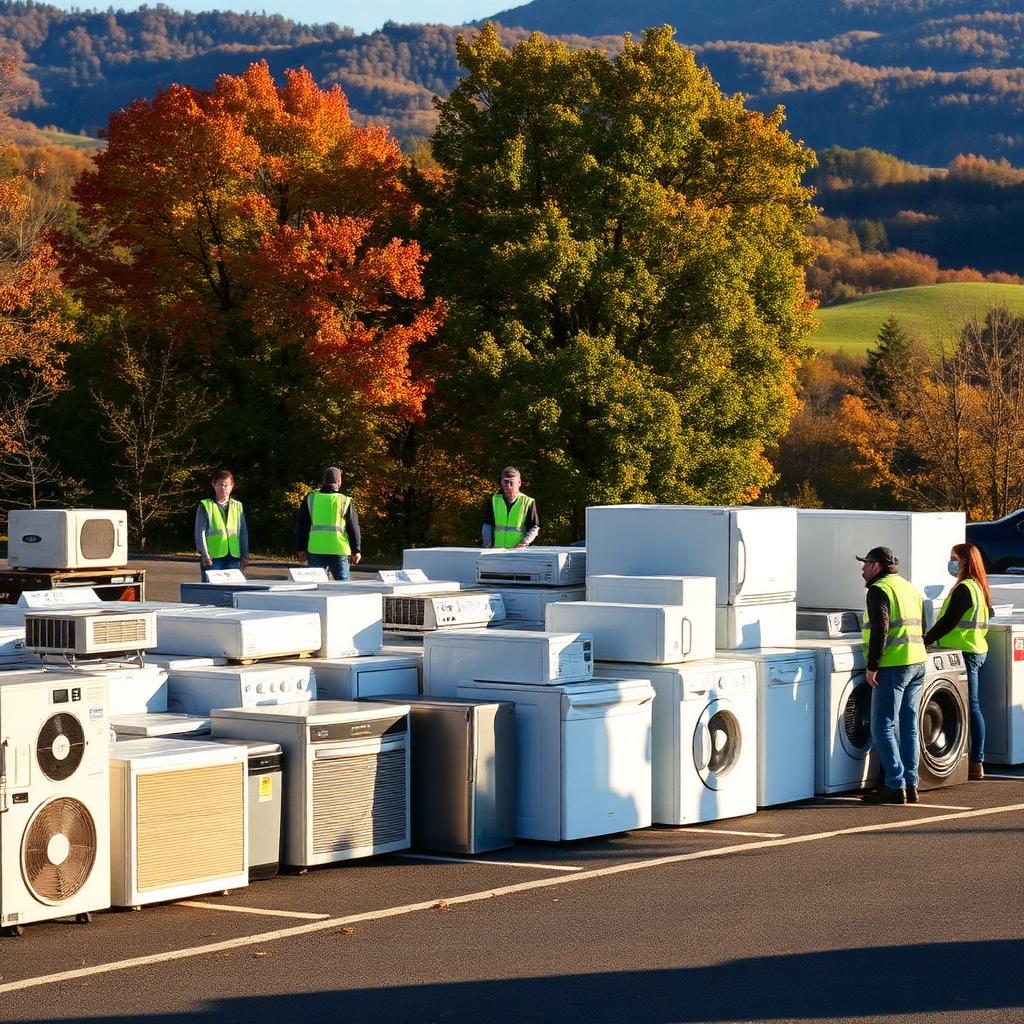
Every spring and fall, thousands of Hudson Valley households swap out an air conditioner, a dying refrigerator, a rusted-out dehumidifier, or an old washer. Most of it ends up on the curb, in a scrapper's pickup, or worse — dumped on a back road. There is a better way, and it isn't complicated once you know where to look.
Why appliance recycling matters. Large appliances contain three things you don't want in a landfill or a creek: refrigerants (the gases inside ACs, fridges, freezers, and dehumidifiers — potent greenhouse gases and, in older units, ozone-depleting), heavy metals and PCBs (in capacitors and older motor oil), and a lot of recoverable steel, copper, and aluminum. Federal law (Section 608 of the Clean Air Act) actually requires that refrigerants be professionally recovered before an appliance is scrapped. A licensed recycler does that; a curbside scrapper usually does not.
Step 1: Know what counts as a 'white good.' In New York, 'white goods' are the large household appliances that need special handling — refrigerators, freezers, air conditioners, dehumidifiers, washers, dryers, dishwashers, stoves, hot water heaters, and microwaves. If it has a compressor, a heating element, or a motor bigger than a hair dryer, treat it as a white good.
Step 2: Use your town or county transfer station first. Every town in Orange County either runs a transfer station or contracts with one. Most accept white goods for a small per-item fee (typically $10–$25 for a fridge or AC, less for a microwave). Bring proof of residency. Ask specifically whether they handle refrigerant recovery on-site or ship the unit to a certified processor — either is fine; both are legal.
Step 3: For big loads, use the Orange County Department of Public Works. The county DPW runs periodic bulk cleanup and household special-waste days, and maintains a list of authorized scrap-metal processors that accept white goods directly from residents. Check the county's Environmental Facilities and Services page before you rent a truck.
Step 4: Retailer haul-away when you buy new. If you're replacing an appliance, the delivery crew from Home Depot, Lowe's, Best Buy, P.C. Richard, or most local dealers will haul the old unit away for a small fee (often free with delivery). Ask specifically for 'EPA-compliant recycling' — the major chains route white goods to certified processors. Get it in writing on the delivery receipt.
Step 5: For window ACs and dehumidifiers, look for a community round-up. Small window units are the hardest category — too heavy for regular recycling, too small for a delivery haul-away. Watch for spring and fall community collection events run by towns like Newburgh, New Windsor, Warwick, Goshen, and Middletown, and by nonprofit partners. Orange Environment posts round-up dates on our events page as they're announced.
Step 6: Never let a curbside scrapper take a fridge or AC without asking about refrigerant recovery. Scrappers do a real service — they keep steel out of landfills. But a scrapper who cuts a line to a compressor without an EPA-certified recovery machine vents the refrigerant straight into the atmosphere. A single old fridge vented that way can be the climate equivalent of driving a car for a year. If the scrapper can't tell you where the refrigerant goes, keep the appliance and take it to a transfer station.
Quick reference — where to go in Orange County. Newburgh residents: City of Newburgh DPW transfer station on River Road. New Windsor: town transfer station on Route 32. Warwick: town recycling center on Route 94. Goshen: town facility off Craigville Road. Middletown: city sanitation department. For every town not listed, call your town clerk and ask for the current transfer-station hours and white-goods fee — they change annually.
Regional certified processors. For contractors, landlords, and anyone with more than one or two units, certified regional processors like Sims Metal (multiple Hudson Valley locations) and Colonial Metals accept white goods directly and provide documentation of refrigerant recovery. That paper trail matters if you're a rental-property owner or a small business.
What Orange Environment is pushing for. Refrigerant venting is one of the largest hidden climate impacts in the region, and the current patchwork of town-by-town transfer station rules makes it too easy for units to end up in the wrong hands. We're advocating for a countywide appliance take-back standard, published pricing, and at least two annual free drop-off days per municipality — because a $25 fee is the difference between a fridge going to a certified processor and a fridge going into a ravine.
One more thing — reuse before recycle. If the appliance still runs, Habitat for Humanity ReStore locations in the Hudson Valley accept working refrigerators, stoves, washers, and dryers less than ten years old. A working appliance kept in service is always better than a recycled one.
Related Orange Environment resources: our clean-energy guide covers heat pumps and heat-pump water heaters as replacements for the appliances you're recycling; our bioregionalism guide explains why keeping steel, copper, and refrigerants inside a closed regional loop matters; and our membership page shows how a $25 check funds this kind of practical, local work.